Key Takeaways
- AI can take over individual tasks, but it does not replace the need for reliable end-to-end processes and trusted operational data.
- ERP is becoming less of an all-in-one application and more of an anchor for processes, data and governance across a broader system landscape.
- The more specialised AI tools a company uses, the more important integration and clear system ownership become.
- Clean data, stable processes and clearly defined responsibilities determine how far AI can be used safely and productively.
- For ERP selection in 2026, integration capabilities and data access matter at least as much as the AI features built into the system itself.
Artificial intelligence has made an old ERP question surprisingly relevant again.
If AI agents can analyse data, generate forecasts, prepare decisions and automate individual tasks, why should companies still need a central ERP system at all?
Because those capabilities still need reliable operational context. They need trusted data, clearly defined processes and somewhere for decisions or actions to return to the business in a controlled way.
That is still one of the main jobs of ERP.
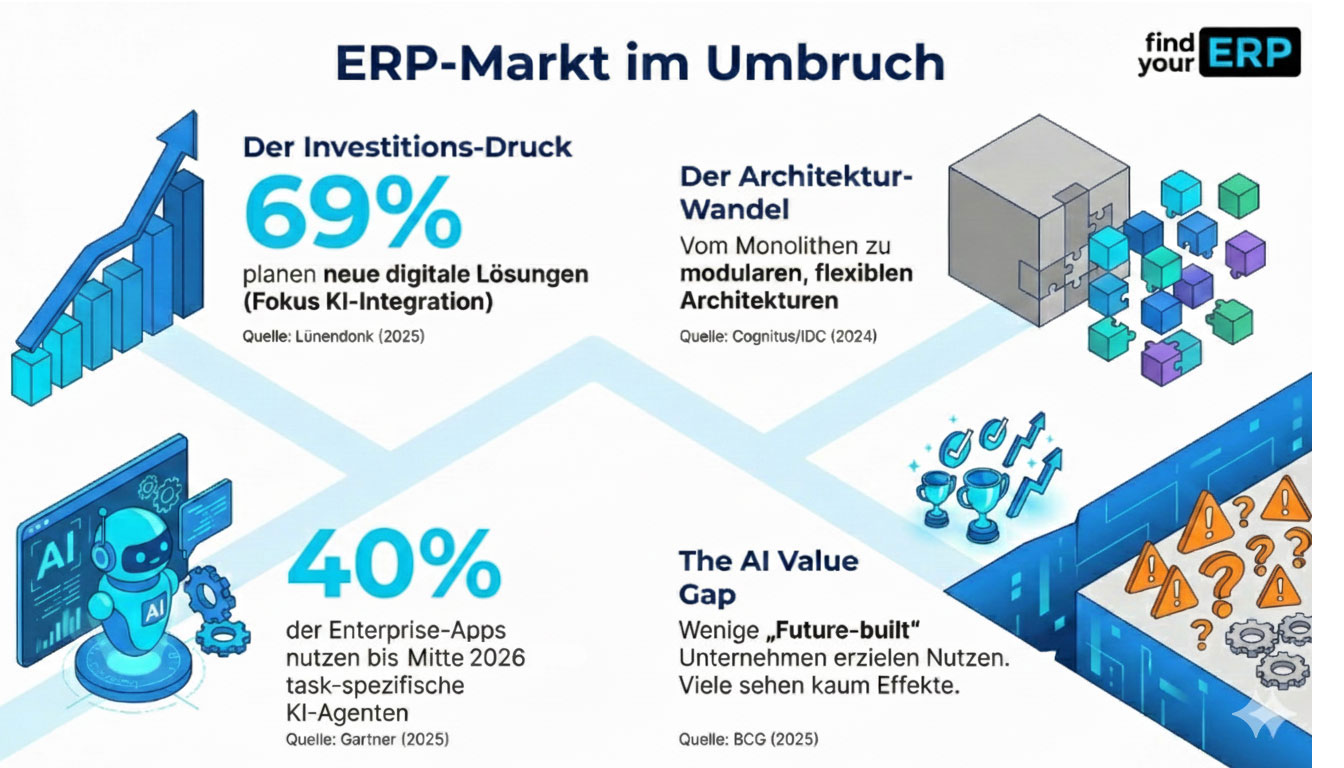
At the same time, the environment around ERP is changing quickly. Despite economic uncertainty, 69% of companies plan additional investment in digital platforms and AI-related solutions over the next two years. Vendors likewise expect demand for AI projects to continue increasing. [4]
So the question is no longer simply whether companies need ERP.
They do.
The more useful question for 2026 is what an ERP system needs to become when more analysis, automation and specialised functionality move outside the traditional ERP core.
Why ERP Still Matters in 2026
ERP systems are easy to underestimate precisely because so much of what they do happens in the background.
Orders are processed. Goods are received. Invoices are posted. Production orders move through defined steps. Financial periods close. Data passes from one department to another.
When these processes work, few people stop to ask which system makes them consistent.
In most organisations, ERP still provides that backbone.
The market itself continues to move towards cloud deployment and ERP modernisation. One estimate puts the global ERP market at USD 73 billion in 2025, with cloud ERP already representing the dominant share. [6]
AI does not remove the underlying need.
Finance, procurement, production, logistics and human resources are not independent activities. They affect one another. A sales order influences inventory and production. Procurement affects cash requirements. Deliveries feed invoicing and financial reporting.
ERP provides the structure that keeps those relationships consistent and traceable.
Specialised applications can often do individual jobs better. An AI forecasting tool may outperform a standard ERP forecast. A specialist application may provide richer planning functionality. An AI assistant may make information easier to retrieve.
But optimising one task is not the same as managing an end-to-end process.
A company still needs to know which data is authoritative, when a transaction becomes binding, who owns a process step and what happens next.
For management, and particularly for CFOs, this matters directly. Month-end closing, liquidity management, delivery performance and profitability analysis depend on consolidated data that can be trusted.
Intelligence is useful. Reliability is non-negotiable.
AI Is Moving Work Out of ERP — and Changing the Role of the Core
Not every activity needs to happen inside the ERP anymore.
That may be the most important change.
AI tools, low-code platforms and specialised business applications make it easier to handle individual tasks outside the traditional ERP environment. Forecasting, analytics, text generation, decision support and smaller automation use cases can often be implemented more quickly in a specialised application.
Task-specific AI agents are accelerating that development. Gartner predicts that by 2026, 40% of enterprise applications will include task-specific AI agents. [1]
This does not necessarily weaken ERP.
It changes what ERP is expected to do.
The traditional model was built around an ambitious idea: bring as many business functions as possible into one integrated application.
That model is becoming less absolute. Analysts expect organisations to move away from purely monolithic ERP architectures and towards more modular environments. [3]
The ERP system increasingly becomes the integrative core rather than the place where every individual function has to live.
A sales team might use an AI-based forecasting application. Controlling might introduce automated variance analysis. HR may use an assistant for internal queries and document preparation.
None of these tools needs to reproduce the entire ERP system.
It does, however, need to fit into the wider operating model.
When an application generates, changes or enriches business information, the organisation needs to know how that information enters the relevant process, which system remains authoritative and which rules apply.
That is where ERP increasingly acts as an orchestrator.
It provides continuity between specialised applications, synchronises key information and gives the wider landscape a stable point of reference.
This also changes ERP selection criteria.
A very large feature catalogue is less compelling if the system is difficult to integrate. Conversely, an ERP does not need to contain every emerging technology if it provides reliable processes, accessible data and well-designed interfaces.
In other words:
An ERP system does not have to own every innovation. It has to make innovation possible.
| Dimension | Traditional ERP Model | Emerging Model |
|---|---|---|
| System role | Central application covering a broad functional scope | Process and data backbone within a wider system landscape |
| Functional scope | Many operational functions bundled inside the ERP | Increasing use of specialised applications alongside the ERP |
| Role of AI | Usually isolated or limited to individual features | AI often operates across or outside ERP applications using ERP data |
| Process control | Processes mainly defined within the ERP | ERP remains the reference point for end-to-end processes |
| Data responsibility | Centralised data storage | ERP increasingly acts as an authoritative reference system |
| Integration | Important but often treated as secondary | Becomes a strategic requirement |
The distinction matters.
The question is not whether a company can buy an “AI ERP”. Almost every major enterprise software vendor now has an AI story.
The harder question is whether the underlying system can support an AI-enabled architecture without losing control of processes, data and responsibilities.
AI Makes Standardisation More Important, Not Less
AI is often associated with flexibility.
Business processes still need structure.
Purchase orders, invoice approvals, production releases, master data maintenance and billing rules all rely on repeatable patterns. They may become more automated, but they do not suddenly become arbitrary.
In fact, AI often exposes weak process design faster than conventional software does.
An AI application needs to know where a process begins, what data it can use, what constitutes a valid result and who is responsible when a decision requires approval.
If those rules are unclear, automation becomes difficult to scale.
A prototype may still work. A single department may even achieve good results. Problems appear when the application has to interact with the rest of the organisation.
That requires:
- Consistent master data that applications can interpret in the same way
- Clearly defined process steps that AI and automation can connect to
- Explicit responsibilities and approvals, including for partially automated processes
Without these foundations, AI tends to remain fragmented.
One application uses one version of a customer record. Another applies different logic. A third generates recommendations that nobody clearly owns.
More technology then creates more coordination work rather than less.
For management, standardisation is therefore not an IT housekeeping exercise.
It is a decision about how the company wants to operate.
Where must processes be identical? Where is variation justified? Who owns the data? Which decisions can be automated, and which still require human approval?
Those questions become more important as AI moves closer to operational processes.
Why ERP Data Is Particularly Valuable for AI
Much of the AI discussion still focuses on how much data an organisation has.
Volume is only part of the story.
For business applications, context is often more valuable.
ERP data has context because it was created inside real processes.
An order is linked to a customer, a point in time and a defined status. A purchase transaction has a supplier, a value and a place in the procurement process. A booking sits within an accounting structure. Production data is linked to material, capacity, quantity and timing.
Those relationships give individual data points meaning.
AI can also work with isolated datasets, of course. But without enough process context, the result tends to remain generic.
Knowing that a number changed is useful.
Knowing when it changed, what business event caused the change, who was responsible and which subsequent processes depend on it is much more valuable.
This makes historical ERP data a substantial asset.
Companies often hold years of information from procurement, sales, production, logistics and finance. Those records contain actual decisions, deviations, bottlenecks and outcomes from the company’s own operations.
They are therefore fundamentally different from generic external data.
Used well, ERP data can support applications such as forecasting, anomaly detection and decision support in a company-specific context.
There is another advantage: governance.
ERP data is normally subject to access controls, internal rules and established responsibilities. Not every employee can access every piece of information, and not every user can execute every transaction.
That becomes important when AI starts using operational data.
The question is no longer simply whether the AI can access a dataset.
It is whether it can access the right data under the right identity, with the right permissions and for the right purpose.
Integration therefore becomes a core capability of modern ERP.
Clean APIs and open interfaces allow specialised applications to use ERP data without bypassing the controls built into the operational system.
This is where ERP can make AI genuinely useful.
Not because the ERP makes the model more sophisticated, but because it connects intelligence to a business context in which something can actually happen.
Generic AI and AI Built on ERP Data Serve Different Purposes
A general-purpose language model and an AI application operating on ERP data should not be treated as substitutes.
They solve different problems.
| Dimension | Generic AI Models | AI Using ERP Data |
|---|---|---|
| Data foundation | Broad external training knowledge | Company-specific process and transaction data |
| Context | Broad general context | Detailed company and process context |
| Connection to operations | Usually indirect | Can be embedded directly into business processes |
| Typical output | Explanations, research and general support | Situation-specific analysis and decision support |
| Operational use | Research, drafting and general assistance | Planning, control and process-related decisions |
| Governance | Depends on deployment model | Can build on existing ERP roles and governance |
Generic AI is highly effective for broad knowledge work.
ERP-based AI becomes more interesting when the question is specific to the company:
What is likely to happen to our inventory?
Which orders are unusual?
Where is a process deviating from its normal pattern?
Which operational decision should be reviewed?
The closer the question moves towards the actual business, the more important company-specific context becomes.
AI Maturity in ERP: From Assistance to Process Intervention
“AI-enabled ERP” is not a particularly useful category on its own.
The label can describe very different capabilities.
A chatbot answering questions is not the same thing as an AI application changing a production plan. A forecast recommendation is not the same thing as automatically approving a transaction.
The more useful distinction is how deeply AI is allowed to influence a process.
BCG describes a significant AI value gap: while some companies are already generating substantial benefits from AI investments, many are still seeing limited measurable impact. [2]
For ERP-related applications, three maturity levels are particularly useful.
| Maturity Level | What the AI Does | Typical Examples |
|---|---|---|
| Assistance & Research | Provides information, answers and guidance | Chatbots, semantic search, text and analysis assistance |
| Decision Support | Analyses data, identifies patterns and recommends action | Forecasts, variance analysis, prioritisation |
| Process-Level Automation | Initiates actions or changes process steps | Automated planning, approval recommendations, adaptive workflows |
At the first level, AI mainly helps employees find or process information. These functions can often be introduced relatively quickly.
At the second level, the technology starts to influence decisions. It detects patterns, evaluates historical data and proposes what to do next. The person remains responsible for the decision.
The third level changes the risk profile.
Once AI can trigger transactions or alter process steps, questions of permissions, auditability and accountability become much more important.
Who authorised the action?
Under whose identity was it performed?
Can the decision be reconstructed later?
Which approvals can the AI bypass — and which can it not?
At this point, AI capability alone tells you very little about whether the use case is suitable for production.
The surrounding process and governance model matter at least as much.
That is why more AI does not automatically mean a better ERP system.
The useful question for ERP buyers is not whether a vendor has AI.
It is what the AI is allowed to do, which data it can use, how its actions are controlled and how well those capabilities fit the organisation’s own level of process maturity.
Hybrid System Landscapes Need an Owner for the Process
Few companies operate a single business application.
Planning tools, CRM systems, business intelligence platforms, document management solutions, specialist industry applications and AI tools all have legitimate roles.
In many areas, specialist software will outperform the corresponding ERP module.
That is not a problem in itself.
The problem begins when nobody can clearly say which system owns the process.
Consider an order-to-cash process.
A CRM system may support the sales activity. An AI application may calculate a forecast or recommend pricing. Another planning tool may assess capacity.
At some point, however, the organisation needs a binding order, delivery information, an invoice and a financial posting.
The outputs from specialist systems have to return to a controlled process.
Without that connection, system landscapes become fragmented. Data is duplicated, process states disagree and management receives conflicting information.
ERP can provide the anchor.
In many small and medium-sized companies, the ERP system will continue to cover a large share of operational processes directly.
Larger organisations tend to have more specialised architectures, with ERP functioning more as a platform anchor between other systems.
The architecture may differ.
The management question does not:
Which system owns the process, and which systems support it?
If that answer is unclear, adding AI usually increases complexity.
If it is clear, specialist applications can be introduced without giving up process control.
ERP Data Is Also a Long-Term Strategic Asset
There is a second reason to look closely at ERP data.
Its value goes beyond the immediate AI use case.
ERP systems contain years of company-specific operational history: orders, deliveries, invoices, postings, changes, exceptions and corrections.
That history shows what actually happened inside the business.
Over time, it also captures patterns that are difficult to reproduce from an external dataset: how demand behaves, where delays tend to occur, how customers order, where exceptions appear and how operational decisions develop.
Generic AI models cannot know those patterns by default.
They belong to the company.
That makes historical ERP data a strategic asset rather than merely an input for reporting.
The value is particularly relevant for CEOs and CFOs because the data is already embedded in an environment with established controls.
There are access rights. Audit mechanisms exist. Responsibilities have been assigned. Data quality can be assessed.
That does not mean every historical ERP dataset is immediately suitable for AI.
Far from it.
Poor master data remains poor data. Inconsistent process histories remain inconsistent. Access rights that were never properly maintained do not become sound governance simply because an AI application is added.
Historical data has to be understood and maintained before it creates value.
But companies that treat their ERP data as an asset rather than a technical by-product are in a much stronger position to develop company-specific AI applications over time.
What This Means for ERP Strategy in 2026
The future of ERP is not a contest between ERP and AI.
The two solve different parts of the problem.
ERP provides structure, transactional reliability, process ownership and operational context.
AI can make that environment easier to use, more predictive and more automated.
The combination is what matters.
This is particularly relevant for small and medium-sized companies. Digital transformation rarely follows a perfect master plan. KfW Research describes how digitalisation activity is shaped by competitive strategy and gradual changes in processes and systems. [5]
That is a useful way to think about ERP as well.
Companies do not need to rebuild their entire architecture every time a new technology appears.
They do need to make sure that today’s ERP decisions do not prevent tomorrow’s use cases.
For management, that means four things:
- Develop the ERP landscape strategically, rather than treating it only as infrastructure that has to be maintained.
- Prioritise integration, including well-designed interfaces, accessible data and clear data ownership.
- Use AI selectively, where it improves a real process or decision instead of adding technology for its own sake.
- Define governance before autonomy, particularly when AI applications are allowed to influence transactions or decisions.
The most useful ERP question for 2026 is therefore no longer:
Do we still need an ERP system?
It is:
Is our ERP environment designed so that AI can use its data and processes without undermining control?
That is a much harder question.
It is also the one that will matter.
Deeper dive: For more on how AI actually gets access to ERP data, the four access patterns available, and why direct database access usually fails in production, see ERP Data for AI: Which Data Access Actually Works (in German).
How Find-Your-ERP Can Help
Whether ERP still makes sense in 2026 is really a question about your own system landscape: how well it integrates, how reliable its data is, and how ready it is for AI-supported processes.
A vendor’s AI roadmap does not answer that question on its own. Your process maturity and data foundation do.
Talk to an ERP Expert
Use an expert call to review your ERP project, current system landscape and key preparation risks before they become implementation problems.
Sources
[1] Gartner. (2025). Gartner predicts 40% of enterprise apps will feature task-specific AI agents by 2026 [Press release].
[2] Boston Consulting Group. (2025). The widening AI value gap: Build for the future 2025.
[3] Cognitus & IDC. (2024). IDC FutureScape: Worldwide intelligent ERP 2025 predictions.
[4] Lünendonk & Hossenfelder. (2025). Lünendonk-Studie 2025: IT-Sourcing-Trends 2025/2026 [Lünendonk study 2025: IT sourcing trends 2025/2026] (in German).
[5] KfW Research. (2024). Dossier Digitalisierung im Mittelstand: Wettbewerbsstrategie prägt Digitalisierungsaktivitäten [Digitalisation in the Mittelstand: Competitive strategy shapes digitalisation activity] (in German).
[6] Cargoson. (2025). How big is the ERP market? (2025).